“The key to investing is not assessing how much an industry is going to affect society, or how much it will grow, but rather determining the competitive advantage of any given company and, above all, the durability of that advantage. The products or services that have wide, sustainable moats around them are the ones that deliver rewards to investors.”
– Warren Buffett
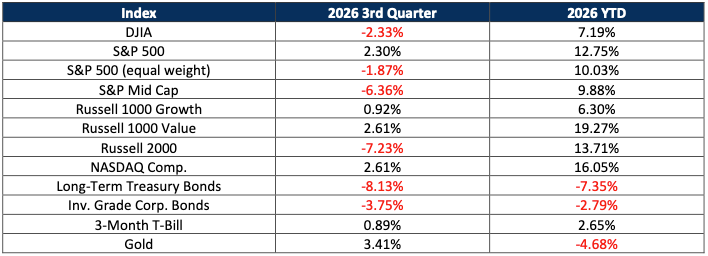
Market Statistics as of 09/30/26
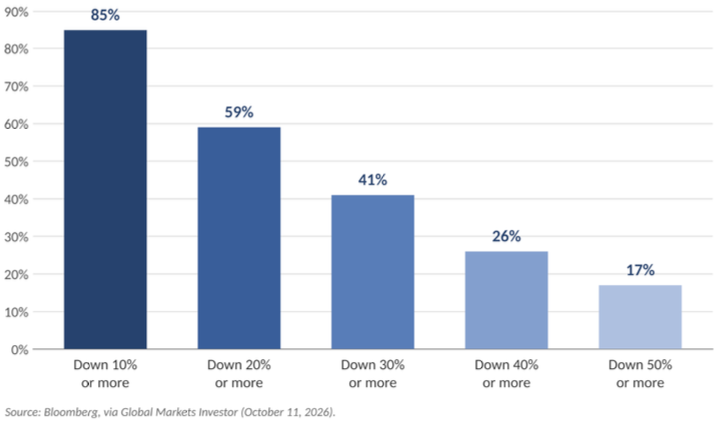
The third quarter of 2026 produced unusually wide performance gaps among asset classes and market indices. The table above captures some of this divergence, but the differences were even more pronounced over the final month or two of the quarter. For the quarter just ended, the S&P 500 generated a 2.30% total return, while the equal-weight S&P 500 Index declined 1.87%, as market leadership shifted back toward mega-cap technology stocks. As we’ve noted in prior letters, the S&P 500 is a market capitalization weighted index, giving the largest companies outsized influence, while the equal-weight index treats every constituent the same. The equal-weight S&P 500 (RSP) fell for seven consecutive weeks after peaking on August 19th, down nearly 7% through quarter-end, its longest losing streak since the 2022 bear market. Meanwhile, the market- cap-weighted S&P 500 finished the quarter just 2.1% below its all-time high of 7,816.90. The gap between those two numbers tells you what the headline index alone won’t; underneath the surface, breadth has deteriorated sharply. Nearly 60% of S&P 500 stocks were trading below their 200-day moving average at quarter end, among the weakest breadth readings in more than a year.
Share of S&P 500 Constituents Below Their All-Time High
Within the S&P 500, energy (+16.48%) was the leading sector, as the war in Iran continued to disrupt oil production and shipping. Information technology (+7.06%) and health care (+6.03%) followed, with communication services (+3.48%) rounding out the sectors with positive returns. On the downside, utilities (-13.03%) were hit hardest as the bond market selloff pushed yields higher and weighed on interest-rate- sensitive stocks. Industrials (-9.91%) and real estate (-6.32%) also declined sharply. Consumer discretionary (-5.24%), materials (-3.19%), consumer staples (-2.43%) and financials (-0.48%) all finished the quarter lower as well. Information technology (+4.42%) and communication services (+4.26%) were the only two sectors to gain in September, historically the weakest month of the year for stocks, and this year was no exception.
“Indexes were originally designed to measure markets, not influence them. As indexing evolved from measurement to investment, however, the act of replication began to influence the market itself.”
– Rob Arnott—Research Affiliates
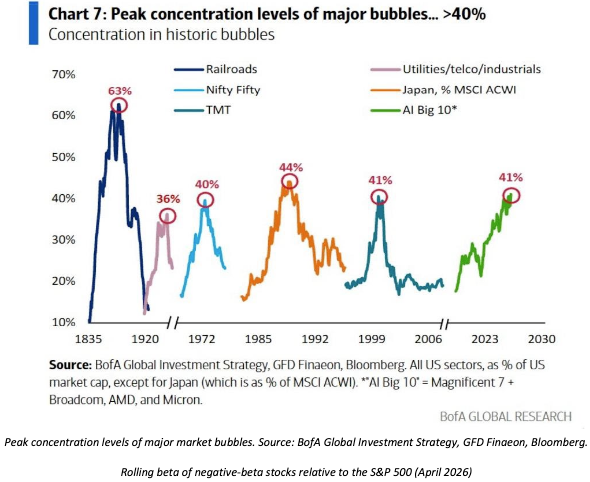
The AI boom’s influence on the S&P 500 is hard to overstate. By various Wall Street estimates, AI infrastructure and AI-related companies now account for somewhere between 30% and 45% of the index’s total market capitalization, depending on how broadly “AI-related” is defined, with most estimates clustering around 40%. Additionally, a handful of chipmakers currently represent more than a quarter of the MSCI Emerging Markets Index. AI-related companies have also become the largest single segment of investment- grade bond issuance this year, and by some estimates now account for roughly 80% or more of venture capital funding year to date, up from well under 40% at the peak of the dot-com bubble in 1999. However, you slice the data; AI has become the market, not just a part of it. The chart on the following page shows how this concentration compares to prior speculative peaks going back nearly 200 years.
We’d also like to briefly address the fixed income market, which has weighed on both the economy and stocks this year. Bond yields have risen sharply over the past six months as inflation remains a persistent problem, and higher oil prices from the war, along with rising commodity costs, have pressured many companies’ margins and earnings. It wasn’t long ago that the Federal Reserve held rates at zero trying to generate 2% inflation. The 10-year U.S. Treasury yield bottomed out around 0.50% in 2020; it closed this quarter at 5.30%. That period may go down as one of the most unusual, and in hindsight poorly conceived, chapters in monetary policy history, and it feels as though we’re now paying the price for it.
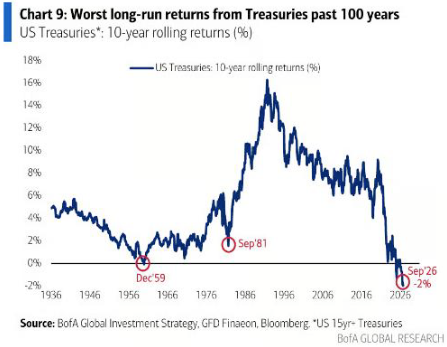
Long-term U.S. Treasuries have suffered their worst 10-year rolling return in at least 100 years, falling below the prior lows set in December 1959 and September 1981. We believe the rise in yields may be due for a pause; late in the quarter, the 30-year Treasury rose from 5.25% to 5.69% in just seven trading days. That kind of sharp move, combined with how washed-out sentiment has become, makes us think a snap-back lower in yields wouldn’t be a surprise. Only time will tell.
Worst long-run returns from Treasuries, past 100 years.
Source: BofA Global Investment Strategy, GFD Finaeon, Bloomberg. (September 2026)
One point worth mentioning; we remain very conservative in our bond strategy, typically buying short-term investment grade bonds with minimal credit or duration risk, so this volatility has had little effect on our client portfolio bond holdings. It’s also worth noting that the S&P 500 dividend yield has fallen to the lowest level in its history, at 1.06%. Not long ago we wrote about TINA — “there is no alternative” — when bond yields were effectively zero. Today, bonds once again offer investors a real alternative for their investment capital.
As our partner Bill Collier noted above, broad markets continue to post positive returns despite rising bond yields and a tenuous geopolitical backdrop. The analogy that comes to my mind is a duck on a pond. Above the water, a duck appears graceful; below the surface, it paddles furiously to keep moving. There is encouraging news: second-quarter GDP growth was revised to 2.2%, consumer spending is rising at a 3.8% annual rate, and unemployment stands at 4.2%. Beneath the surface, however, wars continue on multiple fronts, gas and diesel prices are reaching new highs, mortgage rates exceed 7%, and political uncertainty remains. Meanwhile Mr. Market continues to climb the proverbial wall of worry.
In closing, we remain humbled by and grateful for your trust in us to navigate today’s markets and manage your investments. As always, please reach out with any questions or concerns.
With warmest regards,
Bill Collier
Managing Director
Connor C Keller
Managing Director
DISCLOSURES:
This document is for informational purposes only and does not constitute financial advice. Live Oak Private Wealth (“LOPW”) has prepared this document for the exclusive use by the client or third party for which it was prepared. The information herein was derived from sources considered to be reliable, but the accuracy and completeness cannot be guaranteed. The information contained here is not complete, may change, and is subject to, and is qualified in its entirety by, the more complete disclosures, risk factors, and other important information contained in Part 2A or 2B of Form ADV. Past performance is not indicative of future results.
Live Oak Private Wealth is a subsidiary of Live Oak Bank. Investment advisory services are offered through LOPW, LLC, an Independent Registered Investment Advisor. Registration does not imply a certain level of skill or training. More information about Live Oak Private Wealth, including our advisory services, fees, and objectives, can be found in Part 2A or 2B of our Form ADV, which is available upon request.
This should not be construed as tax advice. You should always consult with your tax professional with regard to specific tax questions and obligations.
Read our full investment commentary and letter to clients by downloading the 2026 Mid-Year letter.
“The idea that a newly issued security (IPO)—brought to market at a time of the sellers’ choosing and surrounded by massive hype—is the single best bargain among thousands of global businesses is absolute nonsense. It makes no sense to buy a security precisely when an insider decides to sell. Frankly, it isn’t worth spending five seconds thinking about IPOs.”
– Warren Buffett
The S&P 500 and NASDAQ just finished their best quarter since 2020, largely driven by AI-related semiconductor stocks. International stock indexes were also strong in the first half of 2026, as evidenced by the MSCI ACWI (ex Us) return of 16.6% (local currency) and 14.00% in USD terms. The equal weight S&P 500 index outperformed the S&P 500 (mkt cap weighted) for the first six months of the year, indicating a broadening of the market. The Mag 7, which has been so dominant over the past few years, was essentially flat on a total return basis for the first half of the year (up 0.1% including dividends). Small cap stocks have been the best performing asset class for both the first quarter and year to date. Value strategies outperformed growth strategies in the first half of 2026 by 10.9%, breaking a multi-year trend of growth (tech) dominance. For the first half, the leading sectors were industrials (+19.46%), information technology (+19.43%) and energy (+17.98%). Lagging sectors were financials (-2.06%), consumer staples (-1.11%) and communication services (+0.44%). As we look forward, not much has changed since our Special Market Update outlining the many risks we were seeing, which we provided to clients in early June. A summary of that update is shown below.
Read our full investment commentary and letter to clients by downloading the 2026 Mid Year letter.
Get Live Oak Private Wealth’s perspective on the shifting investment patterns and the impact on clients by downloading our 2025 Year-End Letter.
“The key to investing is not assessing how much an industry is going to affect society, or how much it will grow, but rather determining the competitive advantage of any given company and, above all, the durability of that advantage.” – Warren Buffett | July 1999
Get Live Oak Private Wealth’s perspective on the shifting investment patterns and the impact on clients by downloading our 2025 Year-End Letter.
Read our full investment commentary and letter to clients by downloading the 2025 Mid-Year letter.
“The odds that you will achieve long-term success by actively trading or timing the market round to zero.”
-Morgan Housel
The S&P 500 experienced a turbulent first half of 2025, with an April swoon that took the index to the brink of a bear market. Renowned investors like Warren Buffett, Jamie Dimon, Ray Dalio, and Stan Druckenmiller voiced bearish concerns, citing high valuations, geopolitical tensions, and economic uncertainty tied to tariffs. From the highs on April 2nd, “Liberation Day” (where Trump rolled out his tariff program), through the lows on April 7th , the S&P 500 declined by a staggering 16%. Despite this pessimism, the S&P 500 then staged a remarkable recovery, rallying 28% from its April lows to close at new all-time highs by June 30th. At Live Oak Private Wealth, while we remained constructive on select market sectors and companies, we certainly did not anticipate a V-shaped recovery or rebound of this magnitude. However, our disciplined, long-term strategy kept clients invested through the downside volatility. As we have discussed on numerous occasions, history has repeatedly shown that market timing is a futile exercise.
Read our full investment commentary and letter to clients by downloading the 2025 Mid Year letter.
Get Live Oak Private Wealth’s perspective on the shifting investment patterns and the impact on clients by downloading our 2024 Year-End Letter.
“It shouldn’t come as a surprise that the return on investment is significantly a function of the price paid for it. For that reason, investors clearly shouldn’t be indifferent to today’s market valuations.” – Howard Marks
Get Live Oak Private Wealth’s perspective on the shifting investment patterns and the impact on clients by downloading our 2024 Year-End Letter.
Tax policy and the temporary or “sunsetting” provisions of the 2017 Tax Cuts and Jobs Act (TCJA) have become a large focus of the 2024 U.S. presidential election.
Tax policy and the temporary or “sunsetting” provisions of the 2017 Tax Cuts and Jobs Act (TCJA) have become a large focus of the 2024 U.S. presidential election. It’s important to understand that on December 31, 2025, this “sunset” expires several tax benefits (including the increased gift, estate and GST tax exemptions) of the TCJA unless Congress passes legislation. For an in-depth description of specific TCJA expiring tax provisions, see Table I included in CRS Report R47846, Reference Table: Expiring Provisions in the “Tax Cuts and Jobs Act” (TCJA, P.L. 115-97), by Margot L. Crandall-Hollick, Donald J. Marples, and Brendan McDermott at (https://crsreports.congress.gov/product/pdf/R/R47846).
How do election outcomes impact tax policy?
For the temporary provisions of the TCJA to be extended or modified, Congress must act. Typically, the biggest policy advancements occur when one party controls the White House and both houses of Congress. In addition to the Presidential race, a total of 468 seats in the U.S. Congress are up for election in November. That includes 33 of the 100 seats in the U.S. Senate (currently under narrow Democratic control) and all 435 seats in the U.S. House of Representatives (currently under narrow Republican control). Whether the election outcome results in one-party control of both houses of Congress and the Presidency, or a split between the parties as exists today, is yet to be seen.
At the presidential level, the candidates continue to issue additional tax policy details as the election approaches. You can stay up to date on tax policies proposed by presidential candidates by visiting the Tax Foundation’s “Tracking 2024 Presidential Tax Plans” resource page at https://taxfoundation.org/research/federal-tax/2024-tax-plans/
What are some of the potential impacts of “sunset” or extension of the TCJA?
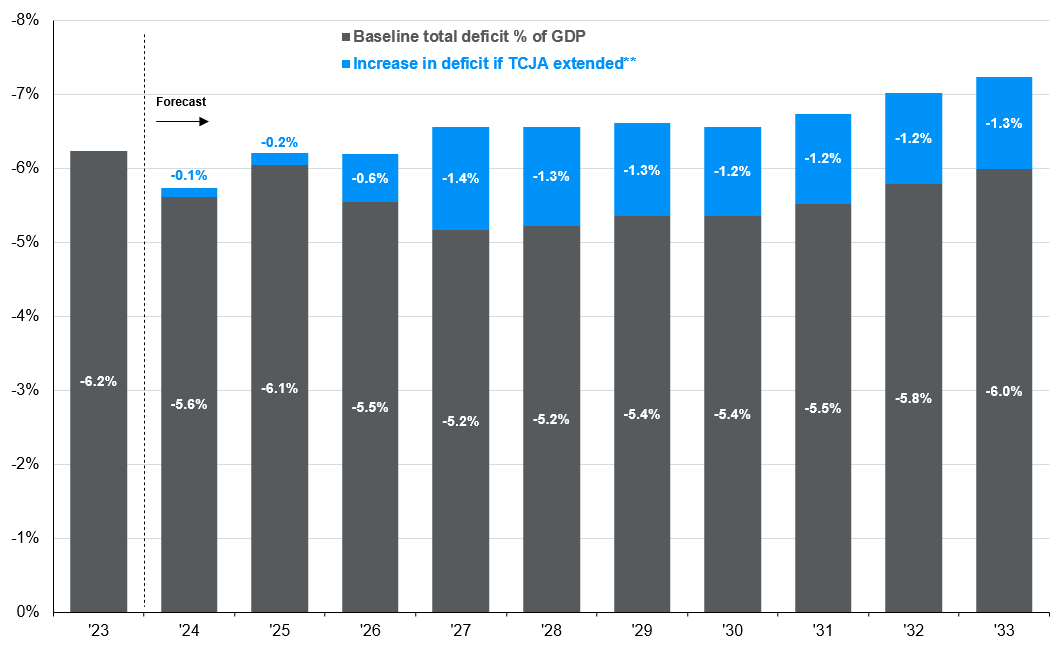
Under current law, the Congressional Budget Office (CBO) projects individual tax revenue to increase after 2024 because of the expiration of tax cuts under the temporary TCJA provisions. If the individual tax provisions are extended, this would create new federal budget deficit concerns from the resulting tax collection reduction (an estimated addition of $2.6 trillion to the federal debt through 2033 – $2.5 trillion from individual tax rate changes and $126 billion from estate tax exemption changes). If the TCJA tax cuts “sunset” and the taxpayers’ bills increase by $2.6 trillion over the next decade, this could impact consumption and consequently growth. This tension is what makes the policy decision delicate and difficult.
Increase in federal deficit if the Tax Cuts and Jobs Act (TCJA) is extended*
% of GDP, 2024 – 2033, impact based on CBO Baselines Forecast Source: CBO, J.P. Morgan Asset Management. *Estimates are based on the Congressional Budget Office’s (CBO) “The Budget Outlook and Economic Outlook: 2024 to 20234.” **Assumes the following provisions from the TCJA are extended: changes to individual income tax provisions, higher estate and gift tax exemptions, changes to the tax treatment of investment costs, and maintaining certain businesses tax provisions going into effect in 2023.
Disclosures:
The opinions referenced are as of the date of publication and are subject to change due to changes in the market or economic conditions and may not necessarily come to pass.
Live Oak Private Wealth is a subsidiary of Live Oak Bank. Investment advisory services are offered through LOPW, LLC, an Independent Registered Investment Advisor. Registration does not imply a certain level of skill or training. More information about Live Oak Private Wealth, including our advisory services, fees, and objectives, can be found in our ADV Part 2A or 2B of Form ADV, which is available upon request.
Read our full investment commentary and letter to clients by downloading the Q3 2024 quarterly letter.
“October: This is one of the peculiarly dangerous months to speculate in stocks. The others are July, January, September, April, November, May, March, June, December, August, and February.” -Mark Twain
What a difference a year can make in the capital markets! As we were writing the 2023 Q3 newsletter last year, it felt like chaos was reigning in the stock and bond markets.
Read our full investment commentary and letter to clients by downloading the third quarter 2024 letter.
Read our full investment commentary and letter to clients by downloading the 2024 Mid-Year letter.
“Reaping dependably high returns from risky investments is an oxymoron. But there are times when this caveat is ignored—when people get too comfortable with risk and thus when prices of securities incorporate a premium for bearing risk that is inadequate to compensate for the risk that’s present.”
-Howard Marks
The second quarter of 2024 saw mixed results for the equity markets as strength continued in mega-cap technology companies, while the rest of the market languished. Massive spending on artificial intelligence has sent the Magnificent Seven (Microsoft, Apple, NVDIA, Alphabet, Amazon, Meta, and Tesla) soaring, and they now make up a whopping 32.8% of the S&P 500 index. Despite the lofty valuations in the Magnificent Seven, investors and algorithmic programs are piling in at the expense of the remaining 493 companies where economic growth appears to be slowing. This has resulted in the third narrowest six-month period ever, with only 24% of stocks in the index outperforming the S&P 500 index.
Read our full investment commentary and letter to clients by downloading the 2024 Mid Year letter.
You are about to leave the Live Oak Private Wealth website.
Disclaimer: This link will take you to a website outside of the Live Oak Private Wealth site. The new site may offer a different privacy policy and level of security. Live Oak Private Wealth is not responsible for the products or services that are offered or expressed on other websites.